Predicted Container Discharge Time
Summary
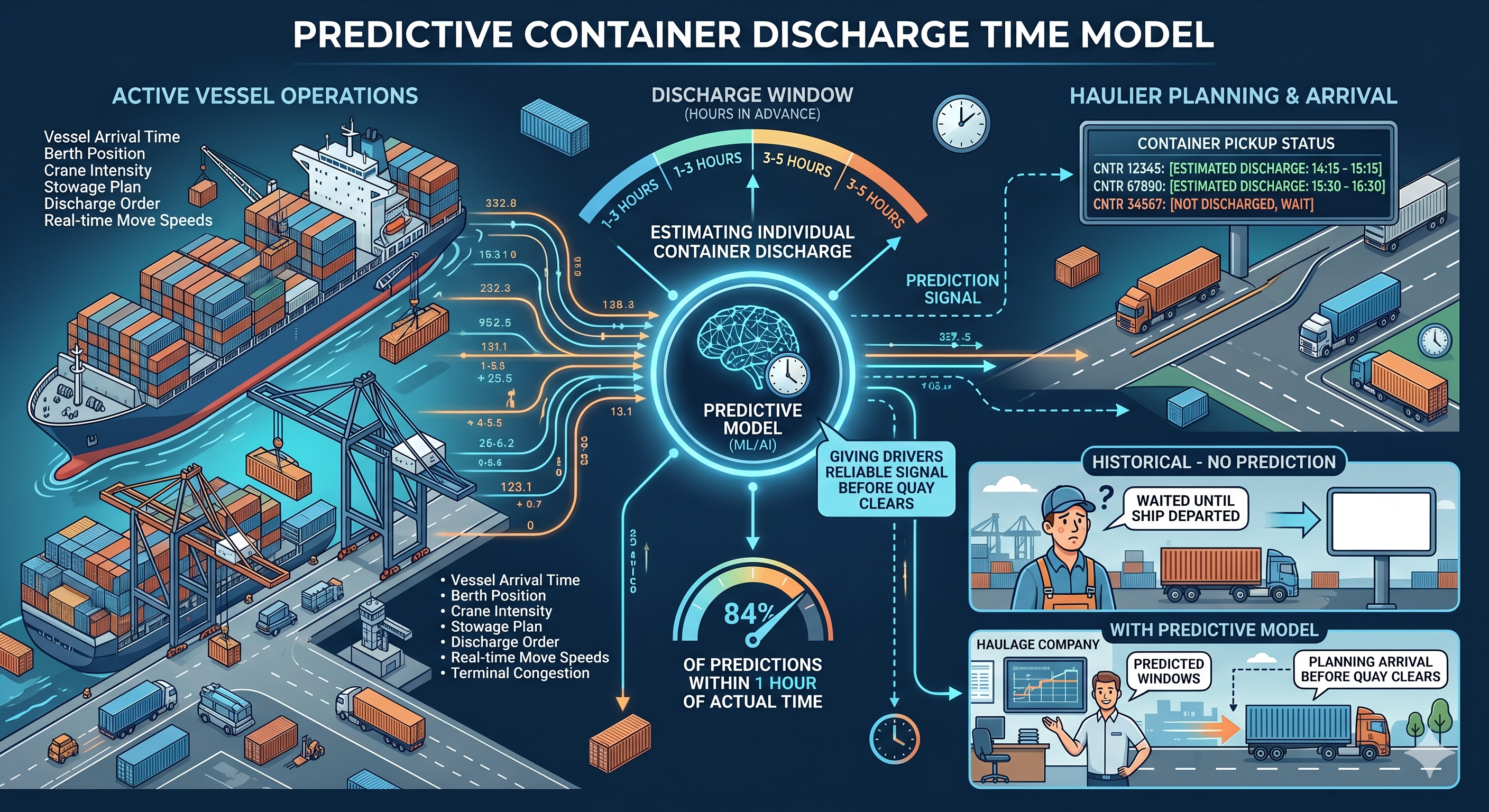
A predictive model estimating discharge time for individual containers during active vessel operations. Truckers historically waited until a ship had fully departed before planning a pickup — with no reliable signal on when individual containers would be accessible. The model gives a discharge window hours in advance, letting hauliers plan their arrival before the quay clears. Achieved 84% of predictions within one hour of actual discharge time.
Context & Problem
Container discharge follows a sequence dictated by vessel stowage plans, crane assignments, and operational priorities. For a trucker waiting to collect a container, the uncertainty is significant — a large vessel can take days to fully discharge, and a container in the lower holds may not surface until the final hours.
The practical consequence was a predictable pattern: truckers would wait until the vessel had departed — a public signal that discharge was complete — before making their move. This created a rush of arrivals in a short window, congesting the gate and yard precisely when the terminal was at its most strained post-discharge.
The root cause was informational, not operational. Truckers weren’t being irrational — they simply had no earlier signal they could trust.
What Was Built
01 · Discharge Sequence Modelling
The model ingests vessel stowage data, real-time crane positions and work queues, and historical discharge rate profiles to estimate when each container will reach the quay surface and be available for collection.
02 · Prediction Window Output
Rather than a point estimate, the model outputs a time window — giving hauliers a usable planning horizon while being honest about uncertainty. The 84% within-one-hour accuracy figure applies to this window.
03 · Haulier Communication Interface
Predictions are surfaced through a notification layer that reaches truckers and logistics coordinators before the vessel departs — giving them enough lead time to adjust arrival scheduling.
Impact
84% of predictions within 1 hour of actual discharge time.
Truckers arrive when containers are ready — not after the ship has left.
By shifting trucker behaviour from reactive (post-departure rush) to planned (staggered pre-departure arrivals), the model reduces gate congestion and yard pressure in the critical post-discharge window.
The improvement compounds: a less congested gate means faster processing per truck, which means the remaining queue clears faster — a positive feedback loop triggered by better information.
Why This Matters
This project is a clean example of how predictive models create value not by replacing decisions, but by giving the people making decisions a better information environment. No trucker needed to change their incentives — they simply needed a signal they could trust.
The 84% accuracy figure is also a floor, not a ceiling. As the model ingests more operational history and the stowage data pipeline matures, that number improves. The architecture was built to retrain continuously as new discharge data arrives.
Role: Lead Developer — Python, Scikit-Learn, XGBoost, TOS Data Pipeline